


Hello everyone .... recently my frnzzz.... have written a test named GATE ...u vl know what is Gate and what it is useful for in following paragraph !
so the reason i posted dz is .... i have found the key for recently written exam on month ending of february !
so here it ............... download KEY from HERE
so the reason i posted dz is .... i have found the key for recently written exam on month ending of february !
so here it ............... download KEY from HERE
WHAT IS GATE ?
The Graduate Aptitude Test in Engineering (GATE) is an all-India examination that primarily tests the comprehensive understanding of various undergraduate subjects in engineering and science. GATE is conducted jointly by the Indian Institute of Science and seven Indian Institutes of Technology (IIT Bombay, IIT Delhi, IIT Guwahati, IIT Kanpur, IIT Kharagpur, IIT Madras and IIT Roorkee) on behalf of the National Coordination Board – GATE, Department of Higher Education, Ministry of Human Resources Development (MHRD), Government of India.
The GATE score of a candidate reflects the relative performance level of a candidate. The score is used for admissions to various post-graduate programs (e.g. Master of Engineering, Master of Technology, Doctor of Philosophy) in Indian higher education institutes, with financial assistance provided by MHRD and other government agencies. Recently, GATE scores are also being used by several Indian public sector undertakings (i.e., government-owned companies) for recruiting graduate engineers in entry-level positions. It is one of the most competitive examinations in India.
General aptitude questions
Each subject's test contains 10 questions that test the "general aptitude" (language and analytic skills), apart from the core subject of the discipline.
Duration and examination type
The GATE examination consists of a single test of 3-hour duration that contains a total of 65 questions, worth a maximum of 100 marks. The questions consist of both multiple choice questions (MCQs) and numerical answer type questions.
From 2014 onward, the examination for all the papers is carried out in an online Computer Based Test (CBT) mode where the candidates are shown the questions in a random sequence on a computer screen. The candidates are required to either select the answer (for multiple-choice question type) or enter the answer for numerical answer type question using a mouse on a virtual keyboard (keyboard of the computer is disabled). Candidates are provided with blank paper sheets for rough work and these have to be returned after the examination. At the end of the 3-hour window, the computer automatically closes the screen from further actions.
Normalized GATE Score (new procedure)
Calculation of "normalized marks" for subjects held in multiple sessions (CE, CS, EC, EE and ME):
In 2014, examination for CE, CS, EC, EE and ME subjects is being held in multiple sessions. Hence, for these subjects, a suitable normalization is applied to take into account any variation in the difficulty levels of the question sets across different sessions. The normalization is done based on the fundamental assumption that "in all multi-session GATE papers, the distribution of abilities of candidates is the same across all the sessions". According to the GATE committee, this assumption is justified since "the number of candidates appearing in multi-session subjects in GATE 2014 is large and the procedure of allocation of session to candidates is random. Further it is also ensured that for the same multi-session subject, the number of candidates allotted in each session is of the same order of magnitude."
Based on the above, and considering various normalization methods, the committee arrived at the following formula for calculating the normalized marks, for CE, CS, EC, EE and ME subjects:
Normalized mark (︿Mij) of jth candidate in ith session, is given by
︿Mij = Mgt - MgqMti - Miq ( Mij - Miq ) + Mgq
where,
︿Mij = Mgt - MgqMti - Miq ( Mij - Miq ) + Mgq
where,
- Mij is the actual marks obtained by the jth candidate in the ith session,
- Mgt is the average marks of the top 0.1 % of the candidates in all sessions of that subject,
- Mgq is the sum of mean and standard deviation of marks of all candidates in all sessions of that subject,
- Mti is the average of marks of top 0.1 % of candidates in the ith session of that subject,
- Miq is the sum of mean and standard deviation of marks of candidates in the ith session of that subject.
After evaluation of the answers, normalized marks based on the above formula will be calculated using the raw (actual) marks obtained by a candidate in the CE, CS, EC, EE or ME subject. The "score" will be calculated using these normalized marks. For all other subjects (whose tests are conducted in a single session), the actual marks obtained by the candidates will be used in calculating the score.
Calculation of GATE Score for all subjects (both single-session and multiple-session):
From 2013, a candidate's GATE score is computed by the following new formula.[7]
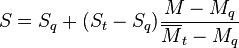
where,
where,
- S = Score (normalized) of a candidate,
- M = Marks obtained by a candidate ("normalized marks" in case of multiple-session subjects CE, CS, EC, EE and ME),
- Mq = Qualifying marks for general category candidates in that subject (usually 25 or μ + σ, whichever is higher),
- μ = Average (i.e. arithmetic mean) of marks of all candidates in that subject,
- σ = Standard deviation of marks of all candidates in that subject,
- Mt = Average marks of top 0.1 % or top 10 (whichever is higher) of candidates in that subject,
- St = 900 = Score assigned to Mt,
- Sq = 350 = Score assigned to Mq.
Old formula
Till 2012, the score was calculated using the formula:
GATE score = 
where,
- m = Marks obtained by the candidate,
- a = Average of marks of all candidates who appeared in that subject, in that year, with marks less than zero converted to zero,
- S = Standard deviation of marks of all candidates who appeared in that subject, in that year, with marks less than zero converted to zero,
- ag = Global average of marks of all candidates who appeared across all subjects in current and past 3 years (i.e. 2010 to 2013 for GATE 2013), with marks less than zero converted to zero,
- sg = Global standard deviation of marks of all candidates who appeared across all subjects in current and past 3 years (i.e. 2010 to 2013 for GATE 2013), with marks less than zero converted to zero.
Qualifying Marks
The rules for qualifying marks have varied from year to year. The qualifying marks (out of 100) are different for different subjects as well as categories.
| Category | Qualifying mark (out of 100) |
|---|---|
| General (GN) | 25 or μ + σ, whichever is higher. |
| Other backward classes (OBC) | 90% of general category's qualifying mark. |
| Scheduled castes (SC) and scheduled tribes (ST) | 2/3 (i.e., 66.67%) of general category's qualifying mark. |
Here μ is the average (i.e., arithmetic mean) of marks of all candidates in the subject (with negative marks converted to zero) and σ is the standard deviation of all marks in that subject.
Usually, the general category's qualifying mark is in the 25 to 30 range.
Before 2008, when the Government of India implemented reservations for other backward classes (OBCs) in college admissions and public sector job recruitment, the OBC candidates were included in the "general" category. There was no separate OBC category then.
Statistics
The number of candidates appearing in GATE is increasing every year.
| Year | Number of candidates appearing |
|---|---|
| 2013 | |
| 2012 | |
| 2011 | |
| 2010 | |
| 2009 | |
| 2008 |
Hope The above statistics helped u my friends !
#all da best 4 ur results maa dea frnzz <3 O:)
#all da best 4 ur results maa dea frnzz <3 O:)


